SLA
Saltwater invertebrateOrange Tube Anemone
Orange Tube Anemone
Couldn't load pickup availability
Orange Tube Anemone: The Deep-Sand Dweller
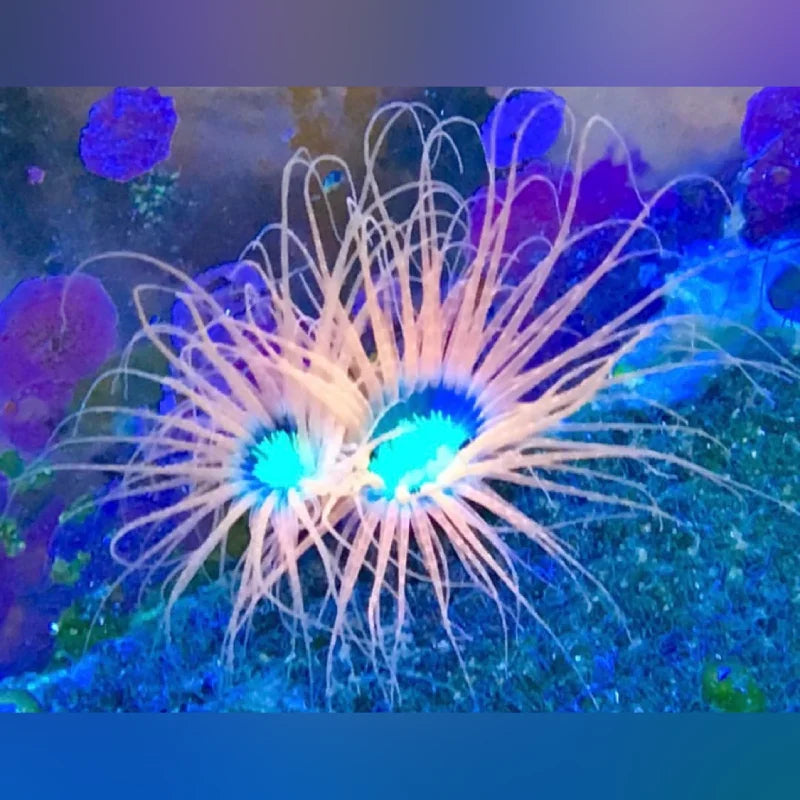
The Orange Tube Anemone (Cerianthus membranaceus), also known as the Cylinder Anemone or Colored Tube Anemone, is a visually captivating invertebrate that is a unique alternative to true sea anemones. Though it shares the common name, it belongs to a distinct class (Ceriantharia) and features two distinct whorls of long, non-retractable tentacles: a long outer set for capturing prey and a shorter inner set for transferring food to the mouth.
The "orange" variety is highly sought after for its vibrant coloration, which often features long, flowing orange tentacles and sometimes a contrasting mouth or inner whorl of a different color. Unlike true anemones, this species does not attach to rock; instead, it secretes a long, tough, fibrous tube made of mucus and specialized stinging cells (ptychocysts), which it buries deep into the substrate.
The Orange Tube Anemone is a non-photosynthetic (NPS) species, meaning it does not require intense lighting to survive. It is a striking centerpiece for a marine aquarium, provided its burrowing needs and predatory nature are respected.
Diet & Compatibility:
- Diet: This anemone is a dedicated Carnivore and non-photosynthetic. It must be regularly fed to thrive. In the wild, it captures plankton, small crustaceans, and even small fish.
- Feeding: It requires regular, supplemental spot-feeding of meaty foods. Feed a mix of mysis shrimp, finely chopped silversides, raw clam, or other meaty seafood several times per week. Target feed the anemone by placing the food directly onto the long tentacles.
- Reef Compatibility: It is Not Reef Safe. While stationary once established in its tube, its tentacles possess a strong sting capable of killing and severely irritating corals and delicate invertebrates, particularly when the current causes the tentacles to sweep the surrounding area. It is best placed in a dedicated Fish Only With Live Rock (FOWLR) system with ample space away from all corals.
- Temperament: It is Semi-Aggressive / Predatory. It is generally peaceful toward tankmates too large to be consumed, but it will sting and eat small, slow-moving fish (especially those that hover near the sand bed), ornamental shrimp, and small crabs.
- Habitat Requirements: The most crucial requirement is a deep sand bed of fine, soft substrate, ideally 4-6 inches (10-15 cm) deep, to allow the anemone to construct and fully bury its protective tube. The anemone prefers Moderate to Low lighting and Moderate water flow, though it is highly adaptable and will usually find a shaded, comfortable spot in the sand.
Quick Facts
- Scientific Name: Cerianthus membranaceus
- Primary Common Name: Orange Tube Anemone
- Other Common Names: Coloured Tube Anemone, Cylinder Anemone, Tube Dwelling Anemone
- Origin: Indo-Pacific, Mediterranean Sea, Northeastern Atlantic Ocean
- Max Size (Oral Disc Diameter): Up to 16 inches (40 cm) in the wild; 8-10 inches (20-25 cm) common in aquaria
- Temperament: Semi-Aggressive / Predatory (Has a strong sting)
- Diet: Carnivore (Requires spot-feeding)
- Minimum Tank Size: 55+ Gallons (Must have a 4-6 inch deep sand bed)
- Reef Compatibility: No (Will sting corals and eat small inverts)
- Care Level: Moderate
Share