AquariumFish.com
Freshwater fishBlue Leopard Angelfish
Blue Leopard Angelfish
Couldn't load pickup availability
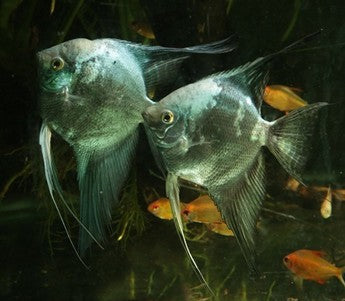
These popular species are bred from a similar pattern found in rivers all throughout the Amazon River basin. From the more mottled pattern of the wild silver angelfish, breeders in Taiwan were able to isolate the blue gene along with the unique marble and spotted "leopard" pattern. One striking feature of the leopard angelfish is that the blue gene becomes apparent at the jumbo size, but do not expect any hint of blue at smaller sizes. If you "google" the picture of a blue leopard, often you will get the picture to the right, a pattern very similar to blue pinoy. Our Indo breeders are notorious for sending either pattern for the leopard, and we never know until they get in. If you are dead set on one or the other pattern, let us know when you order in the comment section or ask prior to ordering!
Quick Facts
| Scientific Name | Pterophyllum scalare |
| Origin | Amazon basin, South America (captive-bred) |
| Care Level | Easy |
| Temperament | Semi-aggressive (territorial when pairing) |
| Adult Size | Up to 6" long and 8" tall |
| Lifespan | 10+ years |
| Diet | Omnivore |
| Water Temperature | 75–82°F |
| pH | 6.0–7.5 |
| Shipping Size | Medium: approx. 1½" · Large: approx. 2" · Jumbo: approx. 4" |
Care Guide
Tank setup: Give them tall plants or driftwood, a heater and a gentle filter.
Feeding: Feed a quality flake or small pellet once or twice a day, only as much as they eat in a couple of minutes. They also enjoy frozen foods like bloodworms and brine shrimp.
Tankmates: Choose peaceful fish too large to swallow, such as larger tetras, corydoras, plecos, rams, gouramis and peaceful barbs. Avoid fin-nippers like tiger barbs, and small fish like neon tetras that adult angels may eat.
Breeding: Angelfish pair off and lay eggs on flat surfaces like broad leaves or slate. A breeding pair can become territorial, so give them room and places for other fish to retreat.
Good to know: The blue color develops with age and is often hard to see until the fish reach about 3", so young fish may look mostly silver or black.
Share