AquariumFish.com
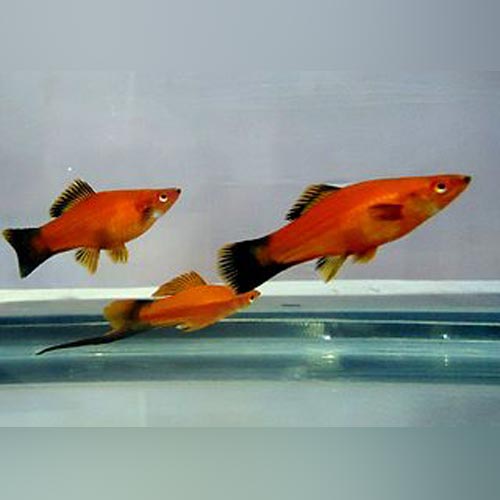
Freshwater fishAssorted Swordtails (Lot of 4)
Assorted Swordtails (Lot of 4)
Couldn't load pickup availability
In the wild, swordtails are found throughout Central America. The males have long extensions on the caudal fin that look like swords. This is absent in females, but they tend to grow slightly larger. They are closely related to the livebearing platy and do well in community tanks. Like guppies and platies, they will breed readily in an aquarium. When we make assorted bunches, we try to pack an even number of males and females, though the ratio may vary.
Lot of 4
Quick Facts
| Scientific Name | Xiphophorus hellerii (assorted colors) |
| Origin | Southern Mexico to Honduras (wild ancestors); aquarium-bred |
| Care Level | Easy, good for beginners |
| Temperament | Peaceful (males may spar) |
| Adult Size | Up to 4–5" (not counting the sword) |
| Lifespan | 3–5 years |
| Diet | Omnivore |
| Water Temperature | 72–79°F |
| pH | 7.0–8.0 (hard water) |
| Minimum Tank Size | 30 gallons (3 ft long) |
| Group Size | 1 male to 2–3 females |
| Shipping Size | Approx. 2" |
Care Guide
Tank setup: Swordtails are active swimmers, so give a group at least a 30-gallon tank (3 feet long) with plants, open swimming space and a tight-fitting lid, since they are good jumpers. They prefer hard, alkaline water. Change about 25% of the water every week.
Feeding: Feed a quality flake or small pellet with some vegetable content (such as spirulina) once or twice a day, plus frozen or live foods like brine shrimp, daphnia and bloodworms a few times a week.
Tankmates: Swordtails get along with most peaceful community fish of similar size, such as platies, mollies, larger tetras, danios, rainbowfish, gouramis and corydoras. Keep one male for every two or three females, since males chase females and may spar with each other. Avoid fin-nippers and large cichlids.
Good to know: Swordtails are livebearers and breed readily. Fry are born free-swimming and will be eaten unless there are dense plants or a breeding box for them to hide in. Only males grow the "sword" on the tail.
Share