SLA
Saltwater fishBanded Pipefish
Banded Pipefish
Couldn't load pickup availability
Banded Pipefish: The Graceful Reef-Dweller
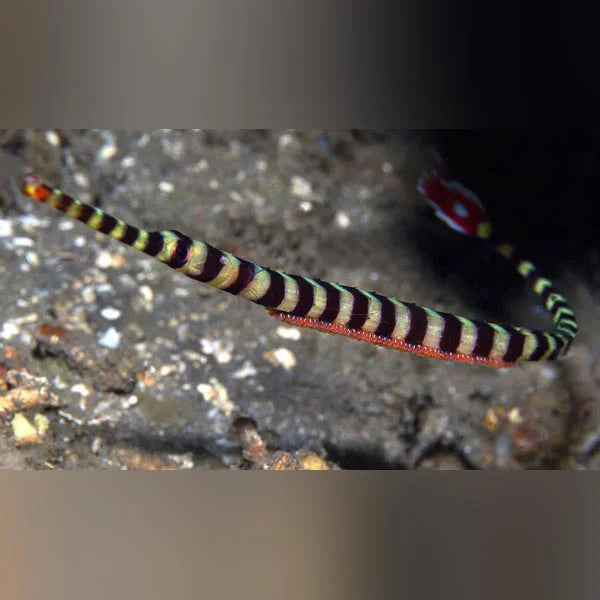
The Banded Pipefish, Doryrhamphus dactyliophorus (often listed under the synonym Dunckerocampus dactyliophorus), is a stunning and graceful fish highly sought after by advanced marine aquarists. Distinguished by its long, slender body and striking color pattern, it is a fascinating member of the Syngnathidae family, which also includes seahorses.
This species features a body banded with alternating red/black and white/yellow rings, culminating in a beautiful, oval or 'flag-like' tail fin that is typically red with a white margin and central spot. The Banded Pipefish is a "flagtail" or "reef" pipefish, making it a stronger swimmer than many of its pipefish and seahorse relatives. In the wild, it is often found in caves and under rocky overhangs on reef slopes throughout the Indo-Pacific, where it exhibits a unique behavior: cleaning parasites from larger fish.
Due to its specialized feeding habits, the Banded Pipefish is considered an Expert-Only species. They require a stable, mature aquarium and a constant supply of live micro-fauna to thrive.
Diet & Compatibility:
- Diet: This fish is a dedicated Carnivore with an extremely small, tubular mouth. Its diet must consist primarily of live foods, such as live copepods (like Tisbe, Tigriopus, or Apocyclops), enriched live baby brine shrimp, and rotifers. They are constant, slow feeders and will starve if they must compete with faster fish for food.
- Feeding: It is crucial to maintain a massive, constantly reproducing population of live copepods in the display tank and/or a connected refugium. While captive-bred specimens are sometimes trained to accept small frozen foods (like Cyclop-Eeze or tiny mysis shrimp), this must be supplemented with live fare.
- Reef Compatibility: It is Reef Safe With Caution. They pose no threat to corals but can be harmed by invertebrates with stinging tentacles, such as anemones or large corals like brain corals. They are generally safe with ornamental shrimp and snails but should be protected from larger, predatory inverts (like certain crabs).
- Temperament: It is Peaceful. The Banded Pipefish is highly social and should ideally be kept as a mated pair or in small groups. They should only be housed with very small, equally peaceful, and slow-moving tankmates, such as firefish, mandarins, seahorses, and non-aggressive gobies.
- Breeding: The Banded Pipefish is a pouch-brooder, meaning the female deposits her eggs into a specialized pouch on the male's underside, where he carries them until they hatch. Captive breeding is possible and preferred for increased hardiness.
Quick Facts
- Scientific Name: Doryrhamphus dactyliophorus
- Primary Common Name: Banded Pipefish
- Other Common Names: Ringed Pipefish, Flagtail Pipefish, Red Banded Pipefish
- Origin: Indo-Pacific (Red Sea to Samoa, north to Japan, south to Australia)
- Max Size: Up to 7.5 inches (19 cm)
- Temperament: Peaceful (Best kept in pairs)
- Diet: Carnivore (Relies on a constant supply of live copepods)
- Minimum Tank Size: 50+ Gallons (Highly stable, mature system recommended)
- Reef Compatibility: With Caution (Avoid stinging corals/anemones)
- Aquarist Level: Expert Only
Share